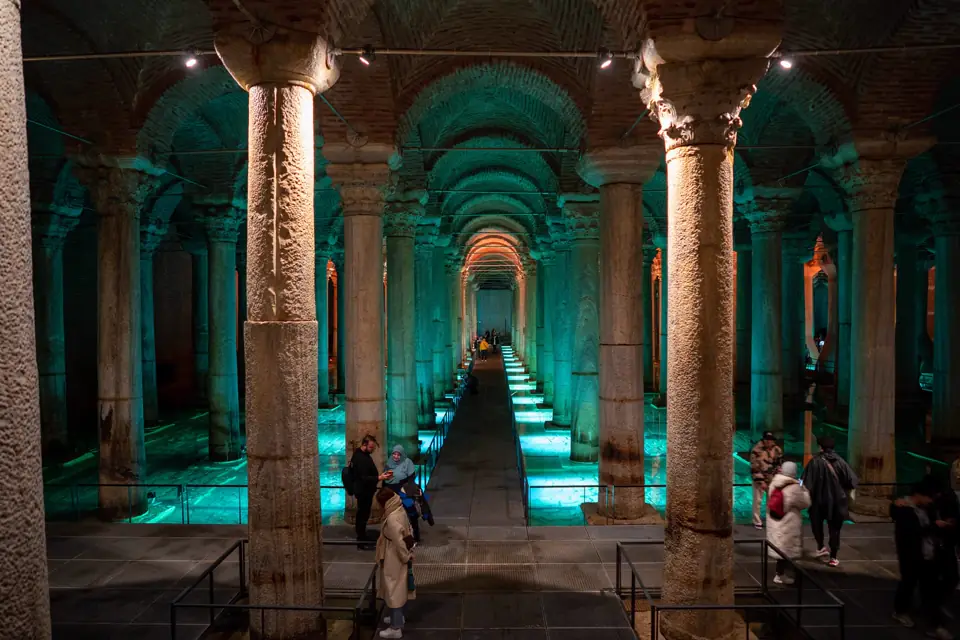
The Story of the 336 Columns
There are 336 columns in total in the Basilica Cistern. They are arranged in twelve rows, with twenty-eight columns in each row. Standing about nine meters tall, the columns support the structure's ceiling together with the arches and vaults above them. But you may have noticed that they don't all look the same. Some of the column capitals bear leaf-shaped decorations. In ancient architecture, this is known as the Corinthian order. Ninety-eight of the capitals in the cistern are in this style. The others are, for the most part, much plainer. These differences arise because stonework from different periods was brought together during construction. In ancient and medieval buildings, it was common practice to reuse older architectural pieces in new structures. In architectural history, this is called the use of "spolia." However, it would be wrong to assume that every capital in the Basilica Cistern was brought from another building. According to the museum's research, most of the capitals date from the period when the cistern was built. Others, however, were taken from older structures. One reason for this was the building's purpose. It was not built to present a grand façade to the public, but to store water. What mattered was not that the stones were decorated uniformly, but that the load-bearing system was sound. Even so, these columns allow us to see the architectural features of different periods in a single space. And one of them stands apart from the rest because of the distinctive decoration on its surface: the Weeping Column.
 NextThe Column of Tearschevron_right